Showing posts with label astrologers. Show all posts

January 11, 2016

The Self-Predicted Death of Astrologer Grant Lewi


I love it when people ask me interesting questions that keep me challenged. This was the best in a long time. Thanks, John.

The question was "What did famous astrologer Grant Lewi see in his chart that enabled him to predict his own death?" Reportedly, Lewi used only transits to make what he called his "projections," incorporating neither progressions, directions, tertiaries, nor harmonics. Therefore, the task of answering this question must also be limited to the methods Lewi used.

I doubt there are any astrologers who don’t know who Grant Lewi was, but in case any non-astrologers happen across this post, he was one of the fathers of modern astrology. He began his career as an English professor, but became so absorbed in the astrology lessons he received from his mother-in-law, that he quit teaching and became a full-time astrologer and author of several books: Heaven Knows What, Astrology for the Millions, and two novels. He wrote for, then became the editor of, Dell Horoscope magazine and also The Astrologer. One of the most important contributions for which we’re in his debt is the Saturn cycle of career success.

Lewi predicted his own death of a cerebral hemorrhage at the age of 49, "to the minute," according to Astrowiki, which places the time of death at 12 noon on July 15, 1951. Wikipedia gives the date of July 14, and also July 15, however no particular time is cited.

Here's a link to his bio on astro.com.


In trying to recreate the same chart Lewi may have used, I had many questions.

First off, according to the Astro Databank, Lewi’s time of birth is given as 8:30 AM "from memory," and rated "A" by Lois Rodden. However, Marc Edmund Jones, often referred to as "the Dean of Modern Astrology," in his book The Sabian Symbols in Astrology, in Chapter 13, page 355, gives Lewi’s birth time as 8:35 AM. He opens the chapter with several pages devoted to the importance of accurate birth data. While my copy is a third printing, published in 1993, the data was first published in 1953. This is a small but important difference, and should be solvable by creating daily harmonic charts for the date of death, using each birth time and seeing which more accurately reflects the death and its cause. Although I’ve done that and the results are posted here,

Grant Lewi Death Harmonic Comparison

I would still like to have more dates with which to test the harmonics. Precious little about Lewi is available online. We have a year of marriage and years of book publications, but no exact date for any of them.

In addition to the birth time dilemma, the time of death at noon sounds rounded off to me, and that is a time often used by astrologers when the real time is unknown (sunrise is the other). No one provides any certification of the time of death, or gives any insight into where this "official time" came from. But it’s what we’ve got, so it’s what we’ll use.

The natal chart provided on Astro.com (a/k/a Astrowiki) uses the Placidus house system with equal houses. But enlarge the chart, and you’ll see the houses are anything but equal. I played with both house systems, and prefer the equal house system because it puts Pisces on the 8th house cusp and eliminates interceptions. On the other hand, the Placidus house system puts Aquarius on the cusp of the 8th house, and the sudden nature of Uranus is more descriptive of the cause of death. Many astrologers use different house systems for different kinds of charts, and with no clear idea of which Lewi may have used for his prediction, I went in search of an answer.

I happen to own an old copy of Astrology for the Millions, so I perused it and was reminded that Lewi liked to use the nodes of the planets, as well as the nodes of the moon. Below is Lewi’s natal chart in the Placidus house system using the most widely accepted time of birth. I’m not sure I accept the time as accurate, but if I’m going to attempt an answer, I should probably work with the same data most others are using. I think if you click on the chart that Blogger will pop out an enlarged version of it. My apologies in advance to any graphic artists out there for all the crumbs left behind due to the many times the charts had to be re-saved.

Just for starters, probably the first thing that brought Lewi’s attention to the probability of his own demise was a solar eclipse in March 1951 (below). It fell into his 8th house of "destruction" as he called it, in square to his natal sun, ruler of his ascendant. In addition, it squared his Uranus - Pluto opposition. Pluto is the planet of death and transformation, and ruler of Scorpio intercepted in his 4th house of endings. Uranus rules his 8th house of death. One more aspect that may have alerted Lewi was a trine to the natal moon in its own sign, and which both ruled and occupied his 12th house, the last of the three houses of endings. We tend to think of trines as being easy and effortless, and that's true, but it's true for both good and ill. 


The lunar eclipse that followed two weeks later at 2 Libra fell into his 2nd house. It squared his natal Neptune (which would have been the ruler of his 8th house in the equal house system), and his natal Mercury, the dispositor of his Gemini sun.

Lewi would also have checked his lunar returns and found that his July return (below) coincided with a new moon, and that the return moon fell into his 8th house, ruled the 8th house, and was the final dispositor of the return chart.


Additionally, Jupiter, the chart ruler, and Neptune, ruler of the 4th house of endings, formed a T-square to the return sun in the 8th house.

In his current solar return (below), which took place June 8, 1951, 29 Aries 59 rose on the ascendant. Be sure to watch for critical degrees, Aries points, and anaretic degrees on the angles in your own charts. The moon’s nodes squared Mars, the chart ruler.


Let’s take a look at those planetary nodes that Lewi favored.


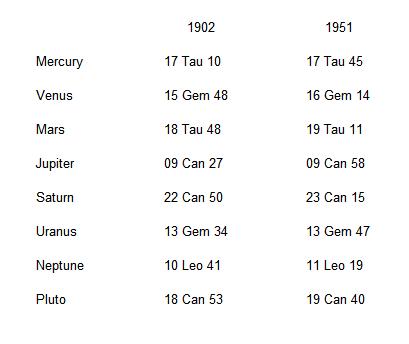
The center wheel is, of course, the natal chart. The outer wheel holds the transits for the time of death. In red are the natal planetary nodes, although I couldn’t fit the text in, so it’s as close as possible while trying to make it still readable. Because the planets stay in the same constant orbit, their nodes barely move and will be only minutes away from the positions they held at birth fifty years before. The positions in the table below are for the north nodes of the planets, and as usual in all but harmonic charts, the south nodes are directly opposite.
If you’d like to find the positions for your own birth, there’s a fantastic generator here:


So that you don’t have to keep scrolling up, here’s the chart again. Interestingly, Lewi was born in a period following three eclipses, and died in a period sandwiched between two others, but explaining the Saros Cycle and prenatal eclipses is beyond the scope of this post.


So far, we know Lewi would have seen the solar eclipse in his 8th house afflicting his natal sun, ruler of his ascendant. Then he probably would have begun looking at the new moons each following month.

In April 1951, the new moon at 15 Aries 50 conjoined one of his prenatal solar eclipses at 17 Aries 48. Transiting Neptune at 16 Libra opposed it, but also trined his natal sun by one minute of orb. In addition, Neptune squared Jupiter.

In May, the new moon at 14 Taurus 44 conjoined the other prenatal solar eclipse at 16 Taurus 25.

In June, the new moon at 13 Gemini 15 conjoined his natal sun as well as the north node of his natal Uranus (13 Gemini 34), ruler of his 8th house. It also conjoined the north node of his natal Venus (15 Gemini 48), ruler of his 4th house (the first House of Endings), and squared the natal part of fortune at 12 Virgo.

On July 4, 1951, eleven days before his death, the new moon at 11 Cancer 32 conjoined the transiting Uranus, which again, is ruler of the 8th (the second House of Endings), which Lewi referred to as the "house of destruction."

In August, the new moon was at 09 Leo 49, exactly conjunct his natal ascendant and the north node of his natal Neptune. An eclipse later that month would occur at 23 Aquarius 25, which made no aspects to his natal chart nor any of the planetary nodes he would have been watching. So maybe he backtracked to see what was happening in July.

He was very interested in Saturn cycles, so maybe he looked there first. Transiting Saturn at 27 Virgo was deep in the "obscure" period and exactly trine his natal Saturn at 27 Capricorn, which ruled his 6th house of health, so no problem there. It was just past an inconjunct to his natal midheaven.

Transiting Uranus, ruler of the 8th (the second of the Houses of Endings), which has just been supercharged by the new moon in Cancer on July 4, and which recently entered his 12th house (the third House of Endings), conjoined the north node of his natal Jupiter. Jupiter only rules the natal 5th house, and is the ancient ruler of Pisces on the 9th, but it’s in mutual reception with Uranus, ruler of the 8th in the natal chart. That might be significant. Transiting Jupiter at 13 Aries would also have squared his natal Chiron at 13 Capricorn in his 6th house of health, but he would not have known that because Chiron wasn’t discovered until 1977. At this point, if he entertained the possibility of his demise, he would likely assume it would be sudden and surprising, like lightning, due to the nature of Uranus (ruling the 8th house). He knows, after all that his health is fine, as Saturn in his chart appears to confirm it.

He would probably have checked Pluto next, and we know he associated it with destruction, as he made note of it in Astrology for the Millions. Transiting Pluto at 18 Leo 38 was separating from a trine to the prenatal solar eclipse in Aries, and a square with the one at 16 Taurus, but it’s only ten minutes shy of a partile square with the north node of his natal Mars, the ruler of his midheaven and the co-ruler of Scorpio intercepted in the 4th house of endings. Pluto sextiles its own place, which isn’t harmful, but is basically insignificant. It trines natal Uranus, ruler of the 8th house, and opposes Jupiter, again activating the mutual reception between Uranus and Jupiter.

Personally, I’m surprised that the transiting moon’s nodes make no particularly interesting aspects to the natal chart other than the conjunction to the natal part of fortune. They do, however make trine and sextile aspects to transiting Uranus, which was supercharged by that new moon on July 4th, eleven days before his death.

Lewi was undoubtedly aware of those long-term transits of the outer planets, as we all are in our own charts. So next he would have searched for aspects made by the faster, inner, personal planets. Transiting Jupiter at 13 Aries 33 was only one minute from an exact sextile to the north node of his natal Uranus, another activation of their mutual reception.

Transiting Mars, which Lewi thought of as having a destructive nature, makes no aspects to his natal planets. Mars is also unaspected in his nativity. At just short of 8 degrees, transiting Mars conjoins the natal north node of Jupiter at 9 Cancer 27.

Venus, ruler of Taurus intercepted in the 10th house, and the 4th house where Libra is on the cusp, makes no harmful aspects to the natal chart, so I’m going to skip it, as Lewi most likely would have. Ditto for transiting Mercury. That leaves the transiting sun and moon.

The transiting sun at 22 Cancer conjoined the natal eastpoint, which is a secondary ascendant, technically where the ascendant would be if he had been born at the equator instead of Albany, New York. It also conjoined the natal north node of Saturn. And finally, the moon trined the ascendant.

At noon on the day of death, the transiting vertex, which is a date with destiny, and which moves at a rate similar to the part of fortune, moved into a sextile (opportunity) to the natal moon which occupied and ruled the 12th house of endings, and had been so revealing in the lunar return.


Grant Lewi wasn't the only astrologer to predict his own death. Click here to see who else did.


Grant Lewi Death Harmonic Comparison


Here is the Daily Age Harmonic for the death of astrologer Grant Lewi. This harmonic uses the widely accepted birth time of 8:30 AM. In this chart, the sun conjoins the ascendant and is trined by the moon. The moon also opposes Neptune, ruler of the static midheaven.

The closest aspect is Jupiter, ruler of the descendant and co-ruler of the static midheaven, in a square to the north node. Jupiter also conjoins Mars, and they receive a trine from the Uranus conjunction to the vertex date with destiny.

Mercury, the chart ruler and also ruler of the 4th house of endings, trines Saturn, ruler of the 8th house, but it’s neither the closest aspect nor the most important.


Below is the Daily Age Harmonic of Lewi using the birth time reported by one of his contemporaries, Marc Edmund Jones. It’s a good example of what a mere 5-minute difference in birth time can make.


i

In this chart, the north node conjoins the ascendant, and is closely squared by Jupiter conjunct Mars at the static midheaven. Mars rules the midheaven as well. Jupiter rules the 6th house of health.

Saturn and Uranus, the two rulers of the 8th house of death oppose the 8th cusp. The part of (mis)fortune trines the north node / ascendant.

In this chart, Mercury, ruler of the 12th house, is conjunct the floating midheaven, and together they sextile the vertex date with destiny. All three form inconjuncts to the eastpoint, which is a secondary ascendant, to form a yod, which is known as the hand of God or finger of fate aspect. It empties into the 10th house of public attention. 


.

May 15, 2015

The Mid-List Astrologer

I am both an astrologer and a writer, two professions that are notoriously low-paying. So, when I recently saw an article on Salon.com written by Ann Bauer and titled, "Sponsored By My Husband: Why it’s a problem that writers never talk about where their money comes from" [1], I was intrigued. For those of you who are unaware of how difficult it is to break into the publishing business—and I doubt there are many, as it seems everyone and her grandmother is writing a novel—the author confessed at the beginning that it was her husband’s financial success and support that allowed her the luxury of being "unemployed" so that she could continue to write.

Ms. Bauer went on to reveal how two other authors, one a seasoned pro and the other an up-and-coming ingénue, misled aspiring writers who asked at book signings how they had supported themselves for the many years it took to complete their novels. The first professed to have struggled, while he is, in fact, heir to a large fortune. The latter said she had remained childless in order to avoid the burden of responsibility that children demand of us. But the untold story was quite different. As the daughter of parents in the publishing business, the ingénue had been raised among the Literati, and her somewhat middling first novel was well reviewed by those who had known her since childhood. It was a bestseller before it was even in print.


Ms. Bauer is what’s known in the publishing business as a midlist author. She isn’t a Stephen King or J. K. Rowling, but just an experienced writer who produces good novels on a steady basis. By the same token, most of us are midlist astrologers. We aren’t blockbusters and celebrities like Linda Goodman or Joan Quigley, but just good, solid middle-class working astrologers. The problem is that the middle class is nearing extinction faster than disposable dollars.


While reading Ms. Bauer’s honest revelations, which fledgling novelists had suspected all along, but to which no one in the publishing industry would ever admit, I saw many similarities with the business of astrology. There is a hierarchy among us just as there is in the publishing business, and those on top are generally there by the same means as best-selling authors. Either they already had the capital to cover the overhead of office space, equipment, software, marketing platform, public image and employees to run their social media, or they were brought up at the knee of the astrological elite. Which is not to denigrate them in any way. I know of at least three who became iconic for blazing astrological trails where no man had gone before. But they were born more fortunate than the rest of us and made the most of their aspects, and as Ann Bauer pointed out, "Pretending otherwise doesn’t help anyone."


Truth be told, there’s a reason astrology was known in the past as the privilege of kings and billionaires. They were the only people who could afford a consultation. Because royalty and plutocrats comprise only about 3% of the world’s current population, it tends to narrow the field of clients who still have disposable income. When times are tough in long Saturnine periods of a drought economy, consulting an astrologer ranks far down on the list of necessities in life, dwelling in sub-basements below children, mortgages, utilities, food, clothing, vehicles, insurance, education, credit card debt … the list is nearly endless. Too large a number of Americans are living hand-to-mouth and one hiccup from homeless. So, along with writers, astrologers can have a bit of a stretch between paychecks. And also in common with writers, as well as the rest of the 47% who don’t earn enough to pay taxes [2], there are no insurance benefits or retirement plans. Some very well known astrologers who have authored textbooks and spoken at conferences have left the field for less glamorous jobs with steadier paychecks. They still make inroads through research, but no one pays for research.

And again, as with writing, the public rarely regards astrology as a real job. It’s perceived as a hobby, something we do as a party trick to amuse others or pick up strangers in bars. As Rodney Dangerfield would say, "I don’t get no respect." Sometimes I am hesitant to tell new acquaintances what I do because they either begin jockeying for position as my new best friend for the astrological benefits, or they’re smug cynics who quip, "If you can predict the future, why can’t you win the lottery?" And the answer is that we can’t rearrange the planets to benefit ourselves; we have to wait for them to come around in their own time. You can hold a paintbrush; why aren’t you Picasso?


As a former journalist for The Washington Post, Malcolm Gladwell’s fascinating books combine an eclectic mix of statistics, psychology, social studies, natural laws, surveys, and a study of biographical facts about the rich and famous. He claims that the key to mastering any field is a matter of practicing a specific task for a total of 10,000 hours. "Ten thousand hours is the magic number of greatness," he concludes. [3] 

The general public has no idea that it takes decades of study and life experience to become an expert astrologer. It’s one thing to memorize cookbook definitions and key words, but they’re just words on paper until we experience for ourselves how planets can devastate our lives, bring enormous joy, or time our crowning achievements. We often don’t gain real insight into how the cycles of the outer planets mark turning points in our destinies until we ourselves have survived a few plot twists in life.


We have always studied the aspects between the planets for all the most important times in history and collected data and cast a chart every time someone notable does something noteworthy. Births, deaths, achievements, arrests. Through the decades we’ve built hefty banks of searchable data and filled trunks with personal memories of how it was to have lived through a particular cycle of transits, like the 60’s, or to have witnessed historic events such as world wars or the Kennedy assassination.


Astrology is our religion. We devour all the texts we can get our hands on that will inform our research and baptize ourselves in theology. Is there a God? A Goddess? Can we answer those questions by stargazing? We have ferreted out the unedited astrology that remains in the Bible, recognize the evolution of an eternal soul, and embrace the theory of reincarnation. We have learned that the Tibetan Book of the Dead and the Egyptian Book of the Dead are one and the same because we took the time to read them both. We know the single common thread that runs through every major religion in the world because we have read their holy tomes. We recognize that the link between science and religion is Newton’s Third Law of Motion. We study the aspects of all the brightest stars in science, medicine, entertainment, politics and world domination, and explore the greatest minds of mankind through their natal charts. We have mapped the cycles of the planets throughout the world’s development, and given pause that the ephemeris for the twenty-first century includes only fifty years.


And yet, how often we’ve felt exploited by clients who asked us to trade work for secondhand clothing we’d never wear or discount coupons for art we could never afford to buy unless we won the lottery. Once when I declined, I was insulted with the phrase, "I know how to handle you Aquarian types." I have had people request a reading and then actually suggest, "Maybe you’re not the kind of astrologer who wants to be paid," as if I dwell in the spiritual world rather than the reality of the material one. In fairness, I have occasionally been thanked with some rather nice gifts from the client’s recent trip to Europe. And Abu Dhabi. And Hong Kong. But these same people would never dream of attempting to pay any other professional in such a manner, nor impose upon them for free work. Students, family, friends, neighbors, even casual acquaintances don’t hesitate to ask for complimentary readings. We get mail daily from complete strangers asking for "a quick question" that would require three or four hours of chart work. And even paying clients tend to monopolize our time and dictate our schedules with their mini-dramas requiring immediate assistance.


Although we may forego the fancy address in favor of low overhead and a little tax break, for most of us, astrology isn’t a hobby or something we do to relax. It’s what we do to put bread on our tables and keep the lights on. Just like creative writing, it’s a job. Some of us have degrees in psychology or liberal arts. But I will add, especially in these times of enormous student loan debt, that in 35 plus years, only once, and very recently, has any client ever asked me if I have a degree or if I am certified by the AFA.


I once read, but can no longer recall who wrote, that two astrologers are all that any mid-size city can sustain. The one with the best marketing skills, though not necessarily the best astrological skills, might maintain a steady client base, and the other will be relegated to giving second opinions to those who weren’t satisfied with the information given by the first. We profess to spread love, enlightenment, mindfulness and a variety of other north node karma goodies around, but a somewhat ugly truth is that it is a competitive business by the sheer need to receive a share of whatever disposable income is afloat. And it’s not only other astrologers with whom we contend. There’s a lot of interesting competition out there for what those in the publishing industry call woo woo. Psychics, hypnotists (especially those specializing in past life regression), reiki masters, Tarot readers, tea readers, palmists, crystal ball gazers, spiritualists, voodoo queens. In the public eye, we’re all one and the same.


In addition, we must also subtract a number of potential clients from the infinite number of fledgling astrologers who are eager to provide cookbook readings to willing victims at no cost, whether or not they can tell Jupiter from Mars. Not only do these over-eager beavers decrease potential income for the midlist astrologers, but they often contribute to a questionable reputation of our craft within the general public.


Astrology is something we do because we have to, like breathing. It’s what we’d do even if we didn’t get paid, the same as writers write. We can’t help ourselves. "Do what you love and the money will follow," is a cliché touted by the wealthy to placate the midlisters of the world. But as Ann Bauer pointed out, to mislead those who are struggling and making great sacrifices to do what they love, or that for which they are destined, does them a disservice. To wrap ourselves in glamour and hide the fact that it can be exceedingly difficult to make a living as an astrologer, when the truth is that most of us need a sponsor to help us through the lean times, doesn’t help anyone.

 
References and Notes 

[1] Ann Bauer, "Sponsored By My Husband: Why it’s a problem that writers never talk about where their money comes from," in Salon.com, Jan 25, 2015.


[2] Lucy Madison, "Fact-checking Romney’s ‘47 percent’ comment," in CBS News, Sep 25, 2012.


[3] Malcolm Gladwell, Outliers: The Story of Success, Back Bay Books, 2011, pp. 38-41


March 16, 2014

In Honor of Dymock Brose, an Extraordinary Astrologer

Dymock Brose, a most generous-hearted Australian astrologer who spent decades teaching us all about harmonic charts, passed at the age of 95 on March 11, 2014. He is survived by his beautiful wife, Marguerite, who will continue his work. She said that he had lost his sight and hearing and passed gently and peacefully from heart failure. With her assistance, he presented lessons every single week for a dozen years of which I am aware, and I'm sure many more of which I'm not. A light has truly gone out in the world. The knowledge and expertise he took with him can never be replaced, but we are fortunate that Marguerite is willing to carry on with it. 

Dymock Brose

September 9, 1918
5:50:04 A.M.
Adelaide, Australia
Tropical
Porphyry (as he would have wished)


Here is the age harmonic chart for his passing.

95. 5064873


He taught us to find the most important feature of the chart which is usually, but not always, the closest conjunction. In this case, the most important feature is the Saturn / Mars / Pluto conjunction in the 8th house of death, squaring Jupiter, ruler of the ascendant (he used the ancient rulers). Uranus, ruler of the 12th house of hospitals (and his natal 6th house of illness) conjuncts the 4th house of endings. Mercury (ruler of his natal sun and midheaven) quincunxes the moon's north node in Leo, sign of the heart, on the cusp of the 6th house of illness and sextiles the south node on the cusp of the 9th house of the longest journey of all. Venus, ruler of the 8th house of death trines Neptune, ruler of the ascendant, indicating a peaceful passing. He deserved no less.

March 22, 2013

So You Want to Learn Astrology

.
.
.
If you need help learning how to find aspects or read transits, go here: http://memphisastrology.blogspot.com/2015/01/finding-aspects.html


Otherwise, here's what you're going to need to start:


THE ABSOLUTE ESSENTIALS


The American Ephemeris for the 20th Century

This is the Bible of astrology. It gives planetary positions for every day of the 20th century (1900 - 2000), which is probably when you were born. This is where you're going to find your natal planets and those of most of the people close to you whose chart you may wish to study, as well as celebrities of this century. This is also where you're going to find a lot of the history you may start out examining: the World Wars, the Great Depression, the sinking of the Titanic, presidential elections and assassinations, scandals, earthquakes, volcanic eruptions, etc. 

Ephemeris' come in two varieties: noon and midnight. I use the midnight one, but that's just personal preference. Whichever you choose, it will show the positions at that time in Greenwich, England, which is where all time zones originate.

Along with planetary positions, an ephemeris contains sidereal times, the dates of lunations (the moon cycle from new to full and back), eclipses (both solar and lunar), declinations (planets north or south of the equator), planet ingresses (the time a planet enters a new sign) last aspects (the time the moon makes its last aspect to a planet until the time it enters a new sign - known as being "void of course"), planetary stations (when the planets appear to change direction) the position of the moon's nodes, Julian dates, the galactic center,  SVP, (synetic vernal point, which is the tropical 0-degree point in the sidereal zodiac, which you will probably never use unless you plan to learn sidereal or eastern astrology), and a monthly position of the asteroid Chiron.

The American Ephemeris for the 21st Century

This is exactly like the ephemeris above except that it only covers 50 years of the current century. You need both. This is where you will find the planetary positions for every day of your future.

Here you will also find the planets of 9/11, the deaths of Saddam Hussein and Osama bin Laden, the election of the first black president of the U.S. (and who knows, maybe the first female president), as well as the future king or queen of England, and hundreds of events and people we do not yet know. Maybe you will be the one to find them.

Amazon wants a stupid amount of money for these. Go straight to the source, instead. Astro Computing


The Michelsen Book of Tables

Chances are that you're going to have every chart you study cast by computer. That's a sign of our times. But are you going to understand what it is that you've done?  In order to really understand astrology, you need a firm grasp of the principles behind it. It's essential that you understand the math and science behind the charts, even if you never cast another one by hand. What if someday the unthinkable happens and we have neither electricity nor computers? How will you cast a chart then? You must know how to do it yourself. It's not that hard! I don't own this one myself, but I believe it contains everything you need for learning to cast charts by hand. 
Also available from Astro Computing.

 - OR -
 
Dalton's Table of Houses

Here's a very inexpensive Table of Houses, which is what I started out with back in the 70's. This is Dalton's Table of Houses. It covers latitudes between 22 and 59 degrees north (If you live in the southern hemisphere, this won't work for you). This is the book you will need to find the ascendant, midheaven, and house cusps of the chart once you have done your math. This one does not teach you how to cast charts. You can get a used one for around $2 and a new one for about $15 from the big evil empire of online books, but you can also shop around.


Below: This is what the inside of a Table of Houses looks like.


 Here is an enlargement of the upper left corner of the image above:


Once you have done your math and know the sidereal time of birth, find it at the top of the page in the Table of Houses, locate the latitude (the grid of the earth that pinpoints location: latitude and longitude. You remember those from middle school, right?) in the left-most column, and voila! There's the degree of your midheaven and ascendant, six houses cusps, altogether. The other six house cusps are exactly opposite. For example, if the midheaven is at 6 Aries, then the ascendant is at 14 Cancer 02, and the 7th cusp is at 14 Capricorn 02. The 8th house cusp is at 8 Aquarius 02. The 9th cusp is at 5 Pisces 02, and so on.

An Atlas, any international atlas

I'm no longer calling this one essential because by the time you have read this far, just about any atlas you buy in print is already obsolete. You might want to get one and keep it handy in case of Armageddon or something, when electricity or the internet are unavailable, and this looks as good as any. What you need it for is look up latitudes, longitudes and time changes. Latitudes and longitudes themselves don't change, but the countries where they are located do, all the time. Where is Siam?  Do you know where Bohemia was? How about Ceylon? Who heard of Myranmar in 1995 when this was published? Do you know the name of the country it used to be? I didn't think so. And time changes happen frequently. Even some states in the U.S. are half in one time zone, half in another. The beginning and ending of daylight savings time changes fairly often, and then there's War Time. It's enough to make you go cross-eyed. I'm going to hook you up with something easy, fast, and online that you can and should use for as long as it is available. I'll provide the link in a moment, but first a warning: It's free - Free charts! Free atlas! Free data bank! Free Personalized Daily Horoscope!  - everything your little heart could desire for casting computerized charts that can be printed out, BUT it's basically meant for people who already know how to cast charts. The hosts are not particularly friendly or helpful. They rarely answer questions, and when they do, they're rather cranky. But they are the absolute best with data. I have never looked up a location I couldn't find (even ghost towns in obscure places), or a time zone that was incorrect. In fact, I double check every chart that I am not 100% sure about by casting it again at this site, and I can't begin to tell you how many times that has saved my butt. Go to the site, bookmark it so you can find it again in a second, familiarize yourself with all they offer, and practice casting charts until you are comfortable. If you mess up, just start over. 
 

................................Astrodienst


Planets in Transit
by Robert Hand

I skipped forward a little here because this category is called absolute essentials. These are books that you cannot do without if you are going to learn astrology. They are not optional

What makes this one special? First, it's written by Robert Hand, who may be the most intelligent and experienced astrologer of this century, and possibly any century. You know that saying, "He wrote THE book?" Robert Hand is that guy. You can never go wrong with one of his books.

The other thing that's special about this one is that in every other book of transits that I have ever studied, the explanations the authors give cover only part of the territory. They begin to give out around Saturn's aspects to Pluto. Once they got there, I guess they either figured it would be redundant to go further, or they just got lazy, or maybe anxious to get their manuscripts published, or who knows?... The truth is Pluto's transit over Saturn is very different from Saturn's transit over Pluto. Neptune's transit over Venus is very different from Venus's transit over Neptune. Uranus' transit over the sun is very different from the sun's transit over Uranus! Robert Hand went all the way. He gives aspects to the ascendant and midheaven as well. Unfortunately, he didn't cover the Moon's Nodes which is a big disappointment to me, or aspects to Chiron, but that's understandable as it is neither a planet, nor does it have a definitive delineation as of yet. Personally, I think the delineations of Chiron feel forced, and although I see it show up in significant places in charts, I am still unconvinced of its real effects. But that's got nothing to do with this book. You need this book. 


PLUTO: The Evolutionary Journey of the Soul
by Jeff Green a/k/a/ Jeffrey Wolf Green

Our earliest philosophers like Plato and Socrates talked about... a priori knowledge - things we are born knowing without ever being taught those things. We know they are true without having to find any evidence, run any experiments, or look for any proof. Astrology is based on the idea that all human beings are eternal souls which exist both within and outside of corporeal bodies. To simplify this for the sake of time and space, and to encourage you to examine this theory for yourself, I'm going to make short of it here and write about it as fact because I believe it to be fact.

After death, the soul reviews its recent life with a Council of Twelve. It learns where it did well, excelled, and failed. Based on that information, and the need to right the wrongs it has perpetrated against others, to complete unfinished business, and for some, to teach or serve humanity, it makes a plan for a new life. It chooses the conditions for that life in ever-smaller circles, but almost always with those with whom it needs to balance its karma. It chooses an eon, an era, a nationality, a race, a religion, a gender, and a relationship to certain others based on its individual needs. It then contracts with other souls to provide the lessons necessary to its plan. That is why we often feel upon meeting others that we have known them before. Or we take an instant liking or disliking to them. Or we feel we're the wrong gender because we have recently switched from one to the other. We wonder how we got "stuck" with our parents or our socio-economic environment. We ask, "Why me? Why am I here? What's it all mean? What am I supposed to be doing with my life?" And so on.

If the other souls we need to make contacts and contracts with are not quite ready, or still in the material world, our time may be spent in rest, study, and reflection. We are then born at the exact moment and place where the planets are aligned to provide the conditions required to fulfill our plans. This book will help you to sort those things out. That world is only a breath away

I bought my copy in a bookstore in Los Angeles. Standing there, reading about my own position of Pluto, I was so astonished that I recorded the date I bought it so I would always know when "I could see clearly now." You can buy yours at Powell's, Barnes & Noble, or even Amazon if you must.

If you would like to know more about this subject now, here are some links for further reading:


NOW THE CHOICE IS YOURS


The A to Z Horoscope Maker and Interpreter
by Llewellyn George

This is a modern version of the book I used back in the day to learn the math and principles of casting charts. It covers the basic principles, constructing the chart, interpretation, simple transits, and advanced techniques such as progressions (but not directions, at least not in my copy). It also has a brief astrological dictionary. It must be easy enough to understand...it worked for me.


The Only Way to Learn Astrology Series
by Marion D. March and Joan McEvers  

 I already knew astrology well before I encountered these books, but I recommend them to students who are working on their own and need it all spelled out for them. I find them a little simplistic, but they do provide the information in a proper order for it to be learned. While looking online for the best place to purchase them, I came up with Goodreads, but I didn't find the rest of the series anywhere. Three more are called The Only Way to Learn About Tomorrow, The Only Way to Learn About Relationships and The Only Way to Learn About Horary and Electional Astrology. They may not be in print anymore, so if you see them anywhere, you should probably snap them up. 


The Astrologer's Handbook
Frances Sakoian & Louis Acker 

This is very basic information found in just about any book on aspects and transits, but where this one goes above and beyond is in its coverage of triplicities and quadruplicities, hemispheres, negative / positive signs, male /female groupings, rulership, exaltations, dignities, detriments, and overlays (although overlays are useless if you have interceptions in a chart). Most books on basics leave these very basic things out. Students eager to fly ahead often overlook these facts of astrology, but they do so at their own peril.


Astrological Patterns
by Frances Sakoian and Betty Caulfield


There is so much to love about this book. It's not just another rehashing of the same old stuff. We call those "cookbooks." Same old same old same old. It doesn't matter which you choose; they all say the same thing with different illustrations. This one offers some enlightening facts that help the astrologer to really understand the person in the chart. You're not always going to have the client sitting in front of you, or even know who it is!  You may have never met the person before, and may not ever meet him. Using the techniques in this book will help you to get a grip on who he is, before the "your sun is in Libra, blah blah, blah."

This book covers the basics like rising signs, house patterns, planetary patterns, hemispheric emphasis and how to judge the strengths and weaknesses of the planets. But then it covers territory I haven't seen in other books, like the Seven Basic Planetary Patterns. Is your pattern a bucket (how important that handle is!), a locomotive (are you a bit of a steamroller, intensely focused?), or a seesaw (back and forth, back and forth always trying to see both sides of a situation)? You could be a splash, a splay, a bundle or a bowl.

This one also covers the natural disposition of the personality. Which planets form the closest square or opposition in the chart? Which planet is in high focus? And what does that mean? 


Mental chemistry is one of my favorite covered topics. Are you an impulsive, high-strung person who jumps to conclusions, or an introvert who mulls things over and slowly comes to a conclusion? Are you impatient or tolerant? Do you stop and listen to others or interrupt while they're relating an event? You don't find the answer in the sun sign, or the rising sign. The secret is in the speed of the moon and the position of Mercury, and you can find it in this book.


If you really want to learn astrology, read everything you can find on the subject until you can separate the wheat from the chaff. Compare what is written to what you see in the charts. Compare what is said to your personal experience. It won't be long until you're reading an article about it and either bury your nose so deeply between the pages that you can barely breathe, or toss it over your shoulder to land against the juncture of the wall and floor while you think that some idiot is just making stuff up for whatever reason of their own, and they sure as hell don't know what they're talking about. Really. It won't take long if you keep at it. 


You should read everything legitimate about astrology that you can get your hands on. Skip the cookbooks that are a waste of money, and instead, subscribe to The Mountain Astrologer, known as the best astrology magazine in the world. As far as I know, it's the only remaining one, but for the sake of argument, it is a very good read, and I highly recommend getting a subscription. It's available in digital and printed formats, every-other-month. It is a great learning tool.

 
There are so many good astrology textbooks to advance to as soon as you are ready. Any books written by the authors above are recommended. In addition, I admire:

Steven and Jodie Forrest
Isabel Hickey
Steven Arroyo  
Marc Edmund Jones
Jan Spiller and Karen McCoy
Alan Leo
Jeanne Avery  
Dane Rudhyar
Martin Schulman
Evangeline Adams
Liz Greene and Howard Sasportas
Ivy Goldstein-Jacobson
Michael Harding and Charles Harvey
Reinhold Ebertin
Erin Sullivan
Grant Lewi