Showing posts with label Trines. Show all posts

January 22, 2015

FINDING ASPECTS


Most people who study astrology on their own learn the cookbook ingredients for signs, planets, and some of the house meanings, but when it comes to aspects, they stall out. And the funny thing is, transits are easy as soon as someone shows you how. Progressions and solar arc directions are read exactly the same way; they simply represent a different time frame.

I remember being about six or seven and looking at my mom’s Dell Horoscope magazines and seeing those little symbols: a square, a triangle, an 8, a star and “that other thing.” I don’t remember if the teeter-totter had taken hold yet. I didn’t know what they meant, and the idea of learning them was daunting. So I didn’t. Not for years. And I think that’s what happens to most people who are interested in astrology. I have a well-rounded astrological library including textbooks and teaching guides by “the greats,” and when I pulled the most likely candidates from the shelves looking for information on aspects, there really weren’t any that demonstrated how to find them. Lucky you; you have the Internet. We didn’t have that when I was learning, and I had to work it out all on my own. I even drew in 360 little tick marks until I figured it out.

Once you figure out the aspects, there will be no stopping you. You’ll be reading charts by the hundreds. You’ll be reading charts for your friends and neighbors. You’ll be everyone’s new best friend. Say goodbye to your free time, say goodbye to that novel you’re writing, say goodbye to your family and furries, because as soon as you learn how to read transits, you will become an addict. You may not stop to eat or sleep for the next two years while you map out your entire future and that of your children and grandchildren. If you don’t already have an ephemeris, or any of the other essential basics, you should just go ahead and start buying them now. If you need unlimited free charts, you can’t do better than astro.com.

We are going to find the Big Five aspects, those known as the Ptolemaic aspects: the conjunction, sextile, square, trine, and opposition. We’re also going to talk about the teeter-totter, which some astrologers call an inconjunct and others call a quincunx. It means compromise, adjustment and sometimes separation. I wonder if it also means indecision? Now I wonder if a yod brings indecision times two. Hmm. More research to do.  Addiction, I’m telling you.

Let’s get started.

There are twelve constellations—Aries through Pisces—and twelve houses. The constellations always contain 30 degrees. That never changes.

Houses, however, change sizes constantly, depending on our location on the earth, the season and time of day. If we use an equal house system, which we rarely do, then every house will be the same size and every house cusp will begin with the same degree and minute as the ascendant, but in successive signs, and every house will be exactly 30 degrees. The 30th degree of one sign is 0 degrees of the next. One degree rises on the ascendant every four minutes.


  • 60 seconds = 1 minute
  • 60 minutes = 1 degree
  • 360 degrees = 24 hours

It takes only basic math to find the aspects. There are 360 degrees in a circle. Divide by 12 and the result is 30, which fits neatly with the constellations. See the illustrations below.


But, as I said, we rarely make equal house charts. So when we look for aspects, we count the number of degrees between the planets, not the number of houses or signs, although, because we know that each sign is always 30 degrees, we can use that information as shorthand. For instance, if the Sun is at 20 Aquarius 21 and Mars is at 21 Cancer 01, and we know the signs always contain 30 degrees, we can quickly sum up in our heads: Mars is 30, 60, 90, 120, 150 (Pisces, Aries, Taurus, Gemini, Cancer) degrees away from the sun, give or take a few seconds, minutes, or degrees. We rarely use seconds, either, so let’s dispense with them and make this even easier. If instead of quickly eyeballing it we want to be specific, we can subtract:
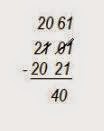


We can’t subtract 21 from 1, so we convert a degree into 60 minutes and add to the original minutes, then subtract, and the answer is 40 minutes. So in this equation, Mars is 150 degrees and 40 minutes from the Sun.

Let’s try the easiest of all, the conjunction. When two (or more) planets are conjunct, they are at relatively the same degree on the wheel, as shown below:


Even without doing the math, we can see that Mars is 24 minutes past the conjunction with the sun. Nothing could be easier.

Let’s try the next closest Ptolemaic aspect, the sextile, which means that two (or more) planets are 60 degrees apart:


In this example, we count 30 degrees from 20 Aquarius to reach 20 Pisces, and another 30 degrees from 20 Pisces to 20 Aries. So there’s our 60 degrees of a sextile. But Mars isn’t exactly at 20 degrees and 21 minutes; it’s a little bit over.


It’s 62 degrees and 4 minutes from the Sun.
Let’s go to the next one.


In this one, Mars is at 24 Taurus 59, only one minute from reaching 25 degrees Taurus. Beginning with the Sun, we count 30 degrees to get to 20 Pisces, 30 more to reach 20 Aries, and 30 more to reach 20 Taurus. That’s 90 degrees, a square. Mars is in a square aspect to the Sun. But it’s a little bit past, so let’s subtract:


Mars is 94 degrees and 38 minutes past the Sun. Next:


In this one, Mars is at 17 degrees and 53 minutes of Gemini. So we eyeball it: from 20 Aquarius to 20 Pisces is 30 degrees, from 20 Aquarius to 20 Aries is 60 degrees, from 20 Aquarius to 20 Taurus is 90 degrees, from 20 Aquarius to 20 Gemini is 120 degrees: a trine. But Mars hasn’t quite made it to 20 degrees of Gemini, so let’s subtract.


We can’t subtract 53 minutes from 21, so we convert a degree into 60 minutes and add them to the original minutes. We now have 19 degrees and 81 minutes. Now when we subtract, our answer is 2 degrees and 38 minutes, which we subtract from 120 because Mars hasn’t quite made it there yet.


We can see Mars is 117 degrees and 22 minutes from the Sun.

Moving on to the next aspect, which Ptolemy didn’t teach us, but we have discovered since, let’s return to the quincunx (also known as the inconjunct). It was the first one we counted, just before the conjunction.


We can see that Mars is 5 signs (at 30 degrees each = 150 degrees) past the Sun. And a hair over.


We can’t subtract 21 from 5, so we convert a degree to 60 minutes, add them to the original minutes, and then subtract. The difference is 44 minutes. Mars is 150 degrees and 44 minutes from the sun.

Let’s look at an opposition. The wheel is 360 degrees, right?  An opposition is half of that, or 180 degrees.


In this one, Mars is at 18 degrees and 6 minutes of Leo, just short of 180 degrees.


See, it’s easy, right?  But so far, you haven’t seen any aspects that are exact, or partile. There’s that little bit over, or little bit short. Are they still in aspect? Let’s talk about orbs.

Here’s a way that might help you understand them. Back when I was a kid, long before video games were invented and people became couch potatoes, we used to play outside even after dark! Sometimes we’d run around chasing each other in a game called Tag. If you got tagged, you became “It,” and had to chase other kids until you tagged one, and he became “It.” There was always a home base, and if you could reach it before you got tagged, you were “free.”  Home base was usually a tree or a streetlight. The streetlight cast a big circle of light on the ground. We still had to reach the light post (become partile), but if we stepped inside the circle of light, you could say we were within orb of it. It’s the same way with the planets. They may not be in exact aspect to each other by having the exact same number of degrees and minutes, but if they’re just a few off, as in the above examples, they’re “within orb” of each other. For you cool folks, you can think of an orb as an aura around each planet. If one planet’s aura is only a few degrees, minutes or seconds difference from another planet, they’re in aspect.


We use larger orbs for the outer planets, and much tighter ones for the inner planets. As you work more with them, you’ll figure out what size orbs work best. I personally use tight ones – five degrees for the outers and two for the inners, but some astrologers use up to ten degrees. The charts I’ve shown you so far are pretty straightforward. But you may be wondering what’s up when you see a wheel like the one below:


What’s wrong with that thing?!?!  Besides the fact that I have removed some tick mark degrees because they are no longer accurate, what’s “wrong” is that it contains interceptions, which means that the houses are not 30 degrees each, which in reality they almost never are. Sometimes, depending upon our location on earth, especially as we get farther from the equator and closer to the poles, the houses become very irregular sizes and some house systems break down altogether. But in most populated areas on earth, it just appears that a house (and, of course, the house opposite) swallows up an entire sign. In this chart, no degree of Aries (nor Libra) touch a house cusp. I’ve dealt with interceptions many times in this blog and am not going to do it again here. What you need to know is how this affects aspects.

It doesn’t.
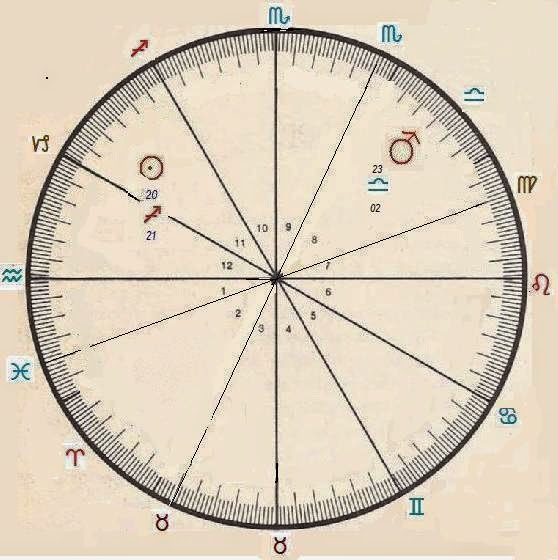


In the chart above, you can see that even though the sign of Libra is swallowed up in the 8th house and Scorpio is on two house cusps, that Mars is still 60 degrees (give or take an orb) from the sun. From 23 degrees Libra to 23 degrees Scorpio is still 30 degrees, and from 23 Scorpio to 23 Sagittarius is still thirty more. While the aspect is separating because Mars has passed 20 degrees, it’s still within orb of the 60 degrees we call a sextile.

Try another one?
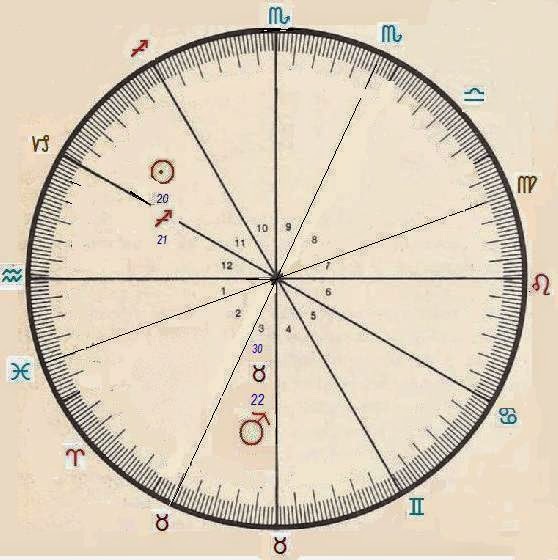


What do you think? Are the Sun and Mars in aspect?

From 20 degrees Sagittarius to 20 degrees Capricorn is 30 degrees. From 20 Cap to 20 Aquarius is 30 more. From 20 Aquarius to 20 Pisces is 30 more, and we’re now at 90 (square). From 30 Pisces to 30 Aries is another 30 which brings us to 120 (trine) and from 20 Aries to 20 Taurus is yet another 30 degrees, bringing us to 150 (quincunx). There’s a 2 degree and 9 minute orb and this is also a separating aspect because Mars has passed the 20th degree.

The chart below is still the intercepted chart with the degrees removed because they’re no longer accurate. But now there’s a new twist: Mars is retrograde. Keep in mind that Mars would never retrograde as far back as I have made it do here. First of all, it takes a boatload of time to create all these graphics, even if they are crappy, so to make the glyph as small as I would need to make it would be excruciating for me to do and for you to see. Secondly, it illustrates my point well, so I’m just going to leave it. I didn’t pick the beginning point of Mars’ transit for any particular reason; it had to start somewhere and that was as good a place as any.


Mars seemed to have begun this particular transit in middle Aquarius, and when it reached nearly to the end of intercepted Aries, it turned retrograde. It moved backward all the way into Capricorn, turned direct, and began to move forward once more. The question is, does it make an aspect to the sun at 20 Sagittarius, and when?

Let’s say Mars began at 15 Aquarius. It moved forward, and when it reached 20 Aquarius, it sextiled the Sun.

When it reached 20 Pisces, it squared the Sun.

When it reached 20 Aries, it trined the Sun.

Before it reached 20 Taurus, it went retrograde and began its backward trek. When it reached 20 Aries, it made its second trine to the Sun.

When it reached 20 Pisces, it made another square.

At 20 Aquarius, it made another sextile.

At 20 Capricorn, it made a semi-sextile to the Sun, but no Ptolemaic aspect. Somewhere in Capricorn, it turned direct and began to move forward again.

At 20 Aquarius, it made its third sextile to the Sun.

At 20 Pisces, it made its third square.

At 20 Aries, it made its third trine.

And when it reached 20 Taurus, it made an inconjunct to the Sun.

The point is that the interceptions make no difference at all. Remember, counting the signs between planets is only shorthand for counting degrees by 30.

Reading aspects to a single wheel chart is easy, isn’t it?  I told you. But, what about when you’re reading a double wheel with the natal planets on the inside and the transits (or progressions or directions) in the outside wheel? Or a triple wheel or quadruple wheel?  If you don’t mind, we’re going to stick with the double wheel. I personally don’t like to read more than two. It gets too cluttered and software generally leaves out the minutes so we don’t know if a planet is at 15 Aries 01, or 15 Aries 59, and it can make a big difference. You can play with those if you want. I know some of you like to load up your charts with every asteroid in the universe, which I think is nonsense and is like trying to read a chart that’s been put through a meat grinder. KISS.

First, let’s look at a real chart:


Anyone who recognizes this chart isn’t likely to be reading this blog post; they already know how to read charts pretty well, I would imagine. I’ll tell you in a bit who it belongs to. When we read natal or diurnal charts, we read them in a clockwise direction.


Remember that the directions in charts are exactly opposite of what they are on earth. East is to your left and south is at the top.

But when we read transits to a natal chart, the natal chart is frozen and does not move, while transits appear to move in the opposite direction, counterclockwise. In the chart below, the sun is approaching the midheaven, not separating from it. Likewise for all the other transiting planets. Transiting Uranus is approaching the 3rd house cusp. Transiting Jupiter is approaching the natal Sun.


The natal chart above is the natal chart of the United States (known as the Sibly chart), and the transits are those for the time the first plane hit the World Trade Center on 9/11. Notice the Pluto / Saturn opposition across the ascendant / descendant axis, Neptune conjunct the South Node, transiting Mercury and transiting ascendant conjunct natal Saturn, and so on.


Whether you prefer to begin with Pluto and work your way in, or begin with the Sun and work your way out, choose the transiting planet you want to start with and one by one look for aspects to the natal planets. In the chart above, the transiting Sun conjuncts natal Neptune and squares natal Mars. Transiting Mercury conjuncts natal Saturn and squares the natal Sun.

.
.

March 7, 2013

The Saturn Cycle of Vivien Leigh


This is Part 2 of The Saturn Cycle of Career Success. Part 1 is HERE.

To read the post on the Saturn Cycle that measures our lives in 7-year increments, click HERE.


Scorpios burn themselves out and eat themselves up and they are careless about themselves - like me. I swing between happiness and misery and I cry easily. I am a mixture of my mother's determination and my father's optimism. I am part prude and part non-conformist and I say what I think and don't dissemble. I am a mixture of French, Irish and Yorkshire, and perhaps that's what it all is.

                                                        ~Vivien Leigh
                                                      
                                              
In this post, we will examine the Saturn Cycle of actress Vivien Leigh, also known as Scarlett O'Hara to the millions of fans of Gone With the Wind. Many others will also remember her other Oscar-winning performance as Blanche DuBois in A Streetcar Named Desire.


Ms. Leigh was born November 5, 1913 at sunset in Darjeeling, India, where some say her father was an officer in the Indian cavalry, and others say he was a stockbroker. In either case, he was an amateur actor who enjoyed being in local plays. Because Leigh lived in India and her mother wanted her to have a proper British education, she was sent away to a convent where she lived and studied.  


Vivien happened to meet another girl there by the name of Maureen O'Sullivan, who came to be widely known as Jane Parker--"Me, Tarzan; You, Jane"--yes, that Jane, who also happens to be the mother of Mia Farrow, who has the most interesting birth name.


Vivien and her friend Maureen played dress-up and decided that someday they would be great actresses, probably much like a scene from The Little Princess with Shirley Temple and Sybil Jason. But I digress again.

As a teen, Ms. Leigh attended schools in England, France, Italy and Germany. She spoke English, French, Italian, and fluent Southern Belle. 


Her natal chart, above, had a majority of planets in fixed signs and a majority in air signs, giving it an Aquarian signature, which would color everything in it, even her Scorpio sun. Her moon was in Aquarius, and was conjunct Uranus, the ruler of Aquarius. The moon also conjuncted her Midheaven. She was an intelligent, intellectual, well-educated woman. She was opinionated and set in her ways, and because these are fixed signs, those things were not easily changed about her.

Unfortunately, her moon squared her sun, which caused a conflict between what she wanted to do vs. what she felt she should do, as well as conflicts between her private persona and her public one. It's a sign of emotional insecurity that restricts self-expression. She undoubtedly thought a lot of things she knew she shouldn't say, but not saying them would be like forbidding the stars to shine.

Scorpio, is a sign known for producing smoldering, mesmerizing people of extraordinary intensity. They can call you from across a crowded room without uttering a word, and the look in their eye that they use to do it will make you blush. They rarely ask for things, preferring to sit quietly and wait for you to realize they want it. When you do, you will hurry to give it to them. They could charm a snake. They are generally quiet and private people unless some poor unknowing soul makes the mistake of scorning them, and then hell hath no fury... This is the all-or-nothing sign. They are deep as wells in mind and soul. They are both sinners and saints.

A man I used to know asked his Scorpio kids why they always wore black,  and they answered, "Because there's nothing darker." That describes Scorpio perfectly when they are in a mood. For your own safety, you should probably steer clear.

Ms. Leigh's moon, which describes her emotional needs, was in Aquarius. Seems just about every other chart I've looked at lately has had the moon in Aquarius. It's humanitarian and wants to make the world a better place, but it's also emotionally distant and difficult to love. A moon-in-Aquarius person examines their feelings, intellectualizes their feelings and understands their feelings, but they don't feel their feelings.

Her Ascendant was in Taurus, so here we have another fixed sign. It's ruled by Venus, which adds to her beauty and charm. She also grew up in the lap of luxury, as befits Taurus, and yet because Venus, as well as her sun, are in the 6th house, she always expected to work for her living. It's just that she knew from an early age what she wanted that work to be. Those people have a jump on life.


As most people do, Vivien had a starter marriage (chart above). She wed her first husband, Leigh Holman, on December 20, 1932, at the age of 19. He was a lawyer and thirteen years her senior. As is often attributed to Saturn, he offered security. Look where Saturn was transiting her chart: conjunct her Midheaven. The pinnacle of career success (according to the astrologer Grant Lewi, who first noted the Saturn Career Cycle of Success). Be that as it may, Saturn conjunct the Midheaven represents a willingness to take responsibility for one's own path and direction in life. Saturn conjunct any angle marks a milestone in life.


In 1935, while Ms. Leigh starred in her first professional play, a young actor named Lawrence Olivier saw her performance and went backstage to meet and congratulate her. Although they were both married, they were attracted to each other and soon began a long affair. I don't have an exact date for that meeting, so can't track her Saturn for it. 


Another thing I don't have an exact date for is the one where she was chosen to play Scarlett O'Hara. There are several stories floating around about it. One says she was told of it on Christmas day. Another says she knew even before the "big search" began when dozens of actresses were screen-tested, and that the search was really only a ploy to maintain public interest in a movie that wasn't even financed to be made yet. In any case, the director, George Cukor, liked what he called Leigh's "incredible wildness," (a trait of Uranus on an angle), and chose her for the role. Another popular anecdote is that the close-up scenes with Clark Gable were torture for her because his dentures gave him severe halitosis. It's hard to know how she might know that, seeing as how she was smoking four packs of cigarettes a day.


We do have a date, although not an exact time, for the premiere of Gone With the Wind in Atlanta, on December 15, 1939. See the chart below: 


You can see that Uranus (change, excitement), which was on her Midheaven at birth is now on her Ascendant (you, here and now), along with the Part of Fortune (luck) of the moment, and all three are trined by transiting Venus (happiness, harmony, beauty) which has just left a conjunction to her natal Jupiter (bigger, better, more, joy) and is heading toward her Midheaven (career, reputation, fame, direction and path in life). But we're tracking Saturn in this post, and where is it? It's in the 12th house, which Grant Lewi said was the time to consolidate your position and build for security rather than expansion. That's why I'm doing this little study: to see if this Saturn theory is correct.

By this time, both Ms. Leigh and Lawrence Olivier have been able to obtain divorces from their respective spouses, and it is said that he proposed to her on the plane on their way home from Atlanta. Whether or not that's true, we have no way of knowing. So much of Hollywood is hype, then and now. However, the position of the planets are in a good position for that the story to be true.

The Academy Awards were held on February 29, 1940 that year, in Los Angeles. Ms. Leigh won the Oscar for Best Actress for her portrayal as Scarlett O'Hara. That's a very honorable achievement, and according to Lewi's Saturn theory, Ms. Leigh's Saturn should be somewhere near the top of her chart at the Midheaven. But it's not. We already know it's way past that. 
 

At the time of this big win, transiting Saturn is still in the "consolidation" sector, and moving quickly toward the "obscurity" sector. It was also making a square aspect to her natal Neptune, planet of glamour and illusion. She once said she found it difficult to live up to the public's expectations, and she hated making films. She preferred stage performances. Recall now that her chart has an Aquarian signature, and notice that the Vertex (fate, a date with destiny) does trine her natal Uranus, moon and Midheaven.

Later that year, Ms. Leigh became Mrs. Olivier on August 31, 1940, with Katharine Hepburn as her maid of honor. 


Where was Saturn on her wedding day? There, exactly on her Ascendant, marking another milestone in her life. Jupiter for joy is also there, along with Uranus, the ruler of her Midheaven and her moon. Transiting Venus, planet of love, was conjunct her Mars, a very appropriate aspect for a wedding.

In 1940, while Saturn hovered around her Ascendant, Ms. Leigh tried several times to be cast opposite her husband in movies, but was thwarted each time, and she did, in fact, enter an obscure period in her career. The couple returned to England, as World War II had begun, and together they went to entertain the troops. But on one of their trips to Africa, she contracted tuberculosis and took several months to recuperate. Then she became pregnant, but miscarried, and entered into a deep depression, later to be diagnosed with what we now call bi-polar disorder.  

Olivier went on to make very successful movies and win several Oscars, and in 1947, he was knighted, becoming Sir Lawrence Olivier (although he preferred to be called "Larry"). While his career soared, hers plummeted. She had another miscarriage, an affair, and more illness. During this time, he also had a clandestine affair - with actor Danny Kaye. His bi-sexuality may have contributed to his admitted failure to consummate his first marriage on his wedding night.

True to the Saturn cycle of "the 7-year itch," Leigh and Olivier's marriage went on the rocks. Like many couples whose finances depend on togetherness, they carried on with the proverbial stiff upper lip. They went to Australia where they appeared on stage together again, but it was the beginning of the end. I haven't been able to find the exact day that Olivier was knighted, nor the day in New Zealand when during a heated argument, they slapped each other before going on stage, just one of many tumultuous fights between them. When I pick a date out of the air, I usually go for the middle of the month, and then adjust forward or backward, depending on what I find. For this exercise, I chose August 15 1947, which was just before their 7th wedding anniversary when I assume they were Down Under, and it just so happens to be quite revealing.


Here you can see that not only is Saturn transiting at the bottom of Ms. Leigh's chart, but it also squares her Ascendant and Descendant axis. The Descendant is the cusp of the 7th house of marriage. Pluto, the destroyer, is also square this axis. There are six planets in Leo - the sun, moon, Mercury, Venus, Saturn and Pluto, all of which square Ms. Leigh's sun in Scorpio, and Olivier's sun in the opposite sign, Taurus. In addition, transiting Mars conjuncted Ms. Leigh's natal Pluto, which is like lighting dynamite. There was bound to be an explosion. Finally, the transiting vertex (fate, appointment with destiny) conjuncted her natal vertex.

In 1951, Ms. Leigh returned to Hollywood to work on the film A Streetcar Named Desire. Olivier went with her to try to keep her in control of her bi-polar disorder. Later, she would be quoted as saying her performance as Blanche DuBois "tipped me over into madness."

She won her second Oscar for playing the role on March 26, 1952.

See the chart below:


Notice that this time, the Vertex (fate, a date with destiny) is conjunct Pluto, the ruler of her Scorpio sun, and the transiting Ascendant is conjunct the sun, itself. Transiting Venus (love, happiness, harmony) is square her natal Saturn. Transiting Saturn, which is retrograde, makes several aspects. It trines its own natal place (achievement, ambition). It trines her natal moon (emotional satisfaction), and it squares her natal Jupiter (bigger, better, more). Transiting Chiron conjuncted her natal Jupiter. I don't believe the true meaning of Chiron has been discovered yet, but it always seems to make an appearance in charts of significant events. As you can see, transiting Saturn is in the sector of the chart Lewi called "The First Rise," indicating progress and development toward the 7th cusp at which time a person "re-emerges" from obscurity. Winning an Oscar is quite a re-emergence, and Saturn still has quite a distance to go before reaching the 7th house.

By this time, both Lord and Lady Olivier were having affairs outside their marriage. Ms. Leigh had a final pregnancy that ended in miscarriage, and her mental health continued to deteriorate. They still worked together and continued to garner good reviews. On January 30, 1953, while filming Elephant Walk in Ceylon, Leigh suffered a major mental meltdown, after which she was hospitalized and began electro-shock therapy (Elizabeth Taylor was called in to take her place).

Transiting Saturn is exactly opposite the position it was in when Leigh won the Oscar for Gone With the Wind - squaring her natal Neptune (illusion, delusion, deception and confusion). It was in the First Rise sector of the chart.

The transiting Moon's Nodes at 12 degrees Leo and 12 degrees Aquarius exactly squared her natal sun (inner life, ego, individuality), as well as the transiting Jupiter which happened to be conjunct her natal Ascendant (you, here and now). Normally, Jupiter on the Ascendant is a very good aspect, but any planet under stress can go awry. In this case, Jupiter represents "over the top." The transiting sun, conjunct the transiting South Node (the bitch node, a malefic) also squared its own place in her natal chart. Transiting Mercury (rational mind, communication) conjuncted her natal moon, which was also ruler of her 3rd house of the rational mind and communication. 

Vivien Leigh never fully recovered from her mental illness, and in 1957, Olivier began an affair with actress Joan Plowright. He left Ms. Leigh in 1958, and they divorced in 1960 after 20 years together, as Saturn once again conjuncted her Midheaven, marking another milestone in her life. Saturn at the Midheaven timed her marriage to her first husband, and now it timed her divorce from Olivier. According to Grant Lewi's Career Cycle theory, this should have been the most public part of her career, the pinnacle of her success.


She did revive her career somewhat, making a movie the next year, and winning a Tony for a Broadway performance in 1963, followed by another movie in 1965. She began living with an old friend from the 40's, Jack Merivale, but reportedly kept a photo of Olivier on her bedside table, nevertheless. Just as the mental illness never left her, neither did the tuberculosis, and on July 7, 1967, she died suddenly at home as a result. Transiting Saturn inconjuncted her natal Sun, and the transiting nodes of the moon squared her natal Uranus (sudden, unexpected, disruptive), the planet ruling her fixed-air signature. Her body was cremated and her ashes were scattered on the mill pond at her home.


Every Hollywood story is supposed to have a happy ending. Whether hers is real or manufactured is up to you to decide. When Olivier heard the news that she had passed, he left the hospital where he was being treated for cancer and rushed to her deathbed where he prayed for forgiveness for all the bad things that had transpired between them, and accepted blame for her illness.

Leigh had long since forgiven him. She told a writer shortly before her death that she would "rather have had a short life with Larry than to face a long one without him." 


Olivier lived another 22 years, devoted to his 3rd wife, Joan Plowright. But in 1986, a visitor to his home found the 80-year old sitting alone, watching an old Vivien Leigh movie on TV. "This, this was love," he reportedly said. "This was the real thing."